
Adult Movie Theatres in Los Angeles
California · last checked 24 September 2026
One adult cinema is still running in Los Angeles: the Tiki, on Santa Monica Boulevard, thirty seats, open around the clock. It has been showing adult films since 1969 and it is the last of them. The city that produced most of the world’s pornography has exactly one room left to watch it in.
What is open right now
Tiki Theatre
Theatre5462 Santa Monica Boulevard, East Hollywood, Los Angeles, CA 90029
- Screens
- One, thirty seats
- Hours
- 24 hours, seven days
- Admission
- A ticket has historically bought a four-hour stay
- Phone
- (323) 466-4264
It opened on 5 November 1969 as the Mini Theatre with a film called Studio F, in a building that had been a market and then a liquor store, and it has shown adult films ever since. It spent years under the Pussycat banner and was signed for a while as the Tiki Theater Xymposium. It was refitted around 2016 with new seats, air conditioning and projection.
Thirty seats, one screen, and reportedly the last cinema in Los Angeles you enter through a turnstile. The Los Angeles Times went to look at it in December 2023 and came to the same conclusion this page does: it is the last one.
Last checked 24 September 2026 · Reviews from May and August 2026
The last Pussycat in America closed here
On 29 October 2022, Studs at the Pussycat on Santa Monica Boulevard in West Hollywood went out of business, and the chain that had thirty houses across California was finished. The owners cited a rent increase, unreliable trade and crime in the area, and did not renew the lease.
The building had been at it since 1940, when it opened as the Monica Theatre. It ran foreign films as the Monica International through the fifties, softcore by the mid-sixties, hardcore from 1969 as the Left Bank, and became a Pussycat in 1970, where it was among the first cinemas anywhere to screen Deep Throat and The Devil in Miss Jones. Later it was the Tomkat, then Studs. Eighty-two years, six names, and it still turns up in listings.
The rule that went to the Supreme Court
After a 1977 study on crime and blight in areas where adult businesses clustered, Los Angeles wrote ordinance 12.70(C). It did not ban anything outright. It said an adult arcade, bookstore, cabaret, motel, theatre or massage parlour could not operate within 1,000 feet of another one, or within 500 feet of a school, a park or a place of worship.
Two businesses sued, Alameda Books and Highland Books, both of which ran a bookstore and a video arcade under one roof and were therefore, by the city’s reading, two adult businesses at zero feet from each other. They argued the First Amendment. In 2002 the Supreme Court sided with Los Angeles, five to four, holding the city could rely on its old study to justify the rule. Justice Kennedy’s concurrence set out the reasoning cities have leaned on ever since: zoning can address the secondary effects of speech without suppressing the speech itself.
Every dispersal ordinance in the country traces back through that case. When a city elsewhere tells an adult business it is too close to a church, it is using Los Angeles’s arithmetic.
One that the record gets wrong
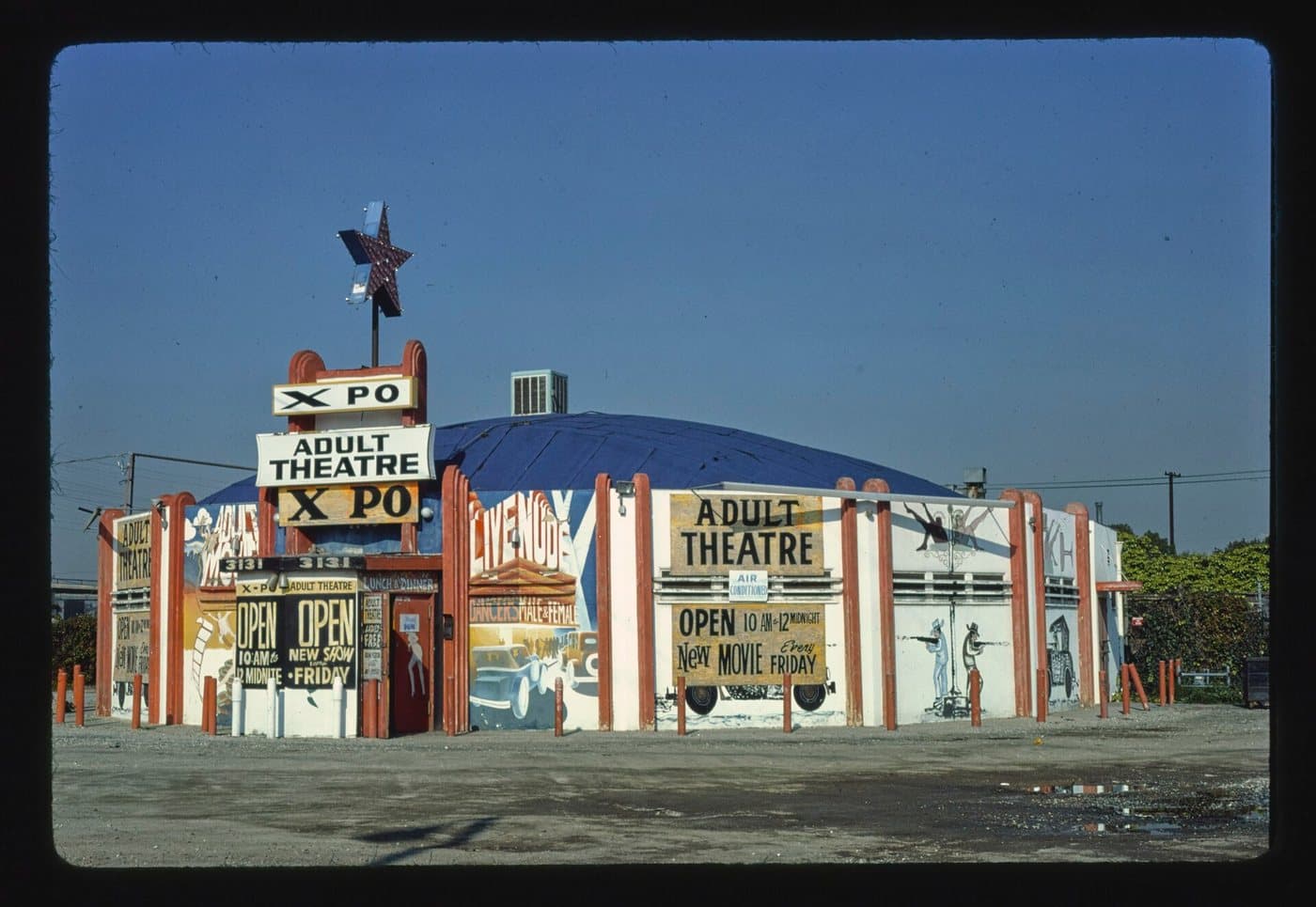
The only directory entry that exists for the XPO says it opened on 4 July 1973, closed in 1974 and was demolished. The photograph above is catalogued as 1977, and the building in it is plainly trading: the signs are fresh, the doors are open, and the house number matches.
A single directory entry, contributed once and never checked, against a federal archive photograph of the building trading three years after its supposed demolition. That is what the record for this subject is like, and it is why nothing on this site rests on one source.
Sources
- Tiki Theatre, Cinema Treasures
- Tiki Adult Theater, Wikipedia
- Studs at the Pussycat Theatre, Cinema Treasures
- Studs at the Pussycat is closing, WEHO Times
- Pussycat Theaters, Wikipedia
- City of Los Angeles v. Alameda Books, Wikipedia
- Xpo Theatre, Cinema Treasures
- XPO Adult Theater 1977, John Margolies, Library of Congress
Something here wrong or out of date? Tell us and we will check it.