
Adult Cinemas in Clermont-Ferrand
Auvergne-Rhône-Alpes, France · last checked 24 November 2026
No adult cinema room or video booth is open in Clermont-Ferrand today. The nearest is Vidéo Zapping in Saint-Étienne, 143.9 km by road from Clermont-Ferrand’s Hôtel de Ville, with private viewing booths and a shared room.
Clermont-Ferrand has none open; Saint-Étienne’s avenue Denfert-Rochereau is the closest
Vidéo Zapping trades at 14 avenue Denfert-Rochereau, 42000 Saint-Étienne, where it offers private viewing booths and a shared room. The drive from Clermont-Ferrand’s Hôtel de Ville is 143.9 km by road, and the shop has its own entry on the Saint-Étienne page.
The Familia, the Novelty on the rue Fontgiève and the Vox, 1920 to 1976
When Le Courrier Cinématographique printed its directory of the Puy-de-Dôme in December 1920, it gave Clermont-Ferrand five cinemas. The Pathé stood on the boulevard Gergovia, the Familia on the place Chapelle-de-Jaude, the Novelty on the rue Fontgiève and L’Idéal on the rue Blatin, with the Magic out in Montferrand. The Alhambra, on the rue de la Selette, was then being built.
The Guide Bleu to the Auvergne and the Centre, in its 1924 edition, still sent visitors to the Familia, the Pathé and the Novelty. Twelve years on, the Novelty and a house called the Rex turned up in the booking lists of La Cinématographie Française, a weekly written for the film business.
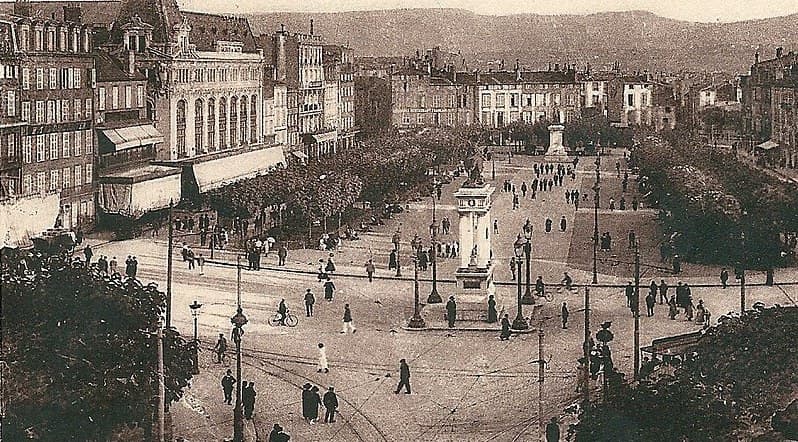
A parish built a screen of its own in the 1930s. Saint-Genès-les-Carmes asked leave on 9 May 1935 to put up a theatre-cinema with a gymnasium at 9 place Michel-de-l’Hospital, had it on 12 July, and saw the salle Saint-Genès finished by September 1938. Its 800 seats were split between the stalls and a balcony, and the projection box sat up on the balcony. The stage frame survives, crowned by a painted frieze of comedy, music and drama.
A trade monthly, Cinéma de France, reported in September 1976 on the city’s screens through an interview with local exhibitors. Clermont then had the Alpha, a complex of five screens, and a house called the ABC, while the Studio, away from the centre, was to be divided into three art-house screens. The same report said that a Clermont house called the Vox, not yet classified as an X-rated cinema, was showing sexy films. Two other Clermont houses had specialised in that kind of film, it added, at least one of them already classified X-rated.
Those classifications came from the 1976 finance law of 30 December 1975. Two of its articles, 11 and 12, gave pornographic films, and films that incite violence, a list of their own, kept apart from the rest of French cinema. In November 1976 the Senate’s culture committee noted that pornographic films had been classed under the new rules since 21 January of that year.
Film control in the Puy-de-Dôme, a Clermont congress of 1925 and the Saint-Genès label, 1916 to 2023
An arrêté of the minister of the Interior, dated 16 June 1916, set up a central commission to vet the films meant for French screens. Mayors lost none of their own powers over shows in their communes, and the 1884 law on communes, in its article 99, let a préfet act in their place, for one town or for the whole département, where they failed to.
In the Puy-de-Dôme neither power was used in those early years. A Paris law doctorate on the censorship of films, defended on 7 March 1934, went through every département up to the summer of 1917. It placed the Puy-de-Dôme among forty-nine where no préfet and no mayor had issued any arrêté on films. Showing films there, in the thesis’s words, stayed entirely free, save for the titles the central commission had turned down.
Clermont-Ferrand hosted the seventh national congress on the birth rate in 1925. Like the congresses held at Marseille in 1923 and Strasbourg in 1924, it passed a wish (vœu) backing a bill to let recognised associations join criminal prosecutions as civil parties, a reform the national congress against pornography had demanded in Paris in 1912. A law thesis defended at Nancy on 23 April 1936 traced the bill through parliament.
The salle Saint-Genès now carries the state label Architecture contemporaine remarquable, awarded in 2023 according to its Mérimée notice, which was created on 14 July 2020 and revised on 11 September 2026. The label is not a protection. Under the heritage code it goes to buildings and other works less than a century old whose design shows enough architectural or technical interest, and it falls away of itself once a building is listed as a historic monument or turns a hundred.
Sources
- Le Courrier Cinématographique, Puy-de-Dôme directory, 18 December 1920
- Guide Bleu, Auvergne et Centre, 1924
- La Cinématographie Française, booking lists, February to June 1936
- Cinéma de France, n° 8, September 1976, exhibitors' interview on Clermont-Ferrand
- Ministère de la Culture, POP, Mérimée notice ACR0000121, Immeuble et salle des spectacles Saint-Genès, 14 July 2020, revised 11 September 2026
- Conseil d'État, 2000, citing articles 11 and 12 of the 1976 finance law
- Sénat, avis n° 66 (1976-1977), tome II, cinema, 23 November 1976
- La Censure cinématographique, law thesis, Faculté de droit de Paris, 7 March 1934
- Law thesis on associations in public and civil actions, Nancy, 23 April 1936
- Code du patrimoine, article L650-1
Something changed in Clermont-Ferrand?
Rooms close, hours move, prices go up and new places open. Tell us what is wrong on this page and we will check it and change it.